

Meeting 6 — October 8, 2025
This meeting brought together representatives from Canada’s cultural, academic, and music sectors to discuss the impact of artificial intelligence on creative industries. Witnesses emphasized that while AI offers opportunities, the current unregulated environment is already harming creators through uncompensated data scraping, cultural homogenization, and threats to copyright and cultural sovereignty.
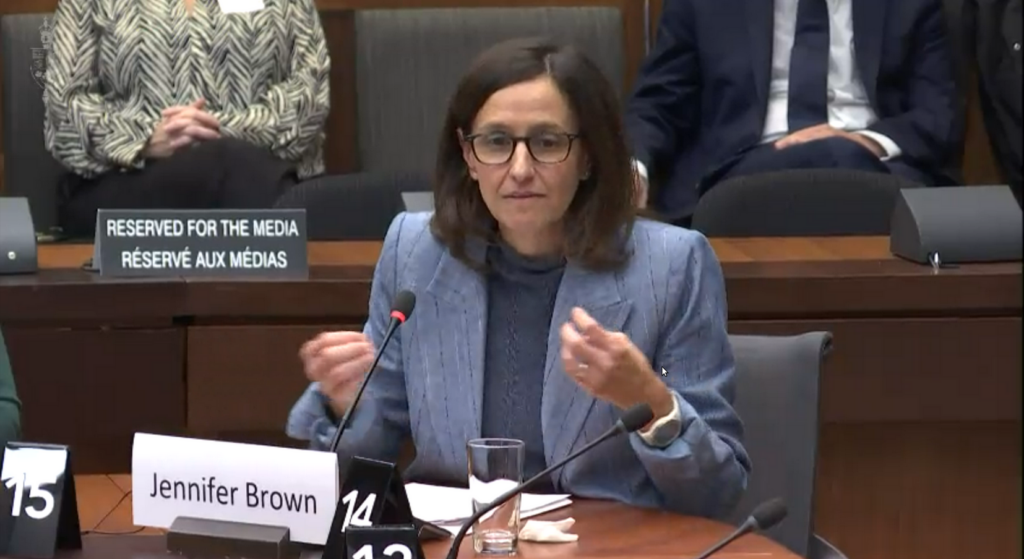
Screen capture of the proceedings which can be viewed here.
Marc‑Olivier Ducharme (ArtIA / Sporobole)
Key Points
- AI development is dominated by foreign technology companies whose priorities undermine Canadian cultural autonomy.
- Creators’ works are being used without consent, contributing to what he described as “digital feudalism.”
- Linguistic and cultural diversity are at risk due to homogenizing algorithmic systems.
- Canada needs Canadian-owned AI labs, cultural data trusts, and training programs to maintain cultural sovereignty.
Selected Excerpts
- “We don’t have a technology problem; we have a digital feudalism problem.”
- “Artificial intelligence is the next frontier of technological colonization.”
- “Without cultural sovereignty, there can be no economic sovereignty.”
Kelly Wilhelm (OCAD University)
Key Points
- Regulation does not stifle innovation; supporting creators strengthens Canada’s innovation ecosystem.
- Creative industries already use AI in production, marketing, and data management.
- Canada needs a national AI education strategy.
- Public, Canadian-governed data infrastructure is essential for ethical AI development.
Selected Excerpts
- “Government action that values creative professionals does contribute to innovation. It does not stifle it.”
- “AI is fundamentally a homogenizing tool.”
Patrick Rogers (Music Canada)
Key Points
- The current AI landscape resembles the early 2000s music piracy crisis.
- Training AI on copyrighted music without permission constitutes infringement.
- Calls for transparency in training datasets and strong copyright protections.
- Warns of the risks posed by deepfakes and synthetic media.
Selected Excerpts
- “We are in the Napster era of AI… We need to get to the iTunes stage so we can get to streaming.”
- “If we’re going to unlock human consciousness with AI, shouldn’t it be able to write a bibliography?”
- “Putting your words in my mouth is not free speech.”
Jennifer Brown (SOCAN)
Key Points
- A significant portion of music creators’ revenue is at risk due to unlicensed scraping of Canadian works.
- AI-generated songs can replace human-created works.
- Strongly opposes any new copyright exceptions.
- Calls for transparency in training datasets and mandatory labelling of AI-generated content.
Selected Excerpts
- “Canadian works are being stolen and scraped by AI companies… without any compensation.”
- “Respect for copyright does not stifle innovation.”
Margaret McGuffin (Music Publishers Canada)
Key Points
- Nearly every Canadian song has already been ingested by AI systems without permission.
- Unlicensed AI models distort markets and undermine fair competition.
- Strongly opposes text-and-data-mining exceptions.
- Emphasizes the need for licensing frameworks for AI developers.
Selected Excerpts
- “Nearly every song ever written by a Canadian songwriter has already been scraped and stolen.”
- “Imagine someone accessing your paycheques without your permission — that’s what’s happening to songwriters.”